
Introduction
Let’s face it: poetry can be a challenge, not only for you as the teacher but for students who struggle to engage and understand. This lesson plan idea is sure to boost your students’ confidence, get them moving and get them sharing in meaningful ways.
I begin this low prep poetry lesson with a reading of each poem. After we read the poem, we take some time to jot down basic summary details: who, what, when, where. Depending on the complexity of the poems, I’ll throw in some motifs at the bottom of the page as hints.
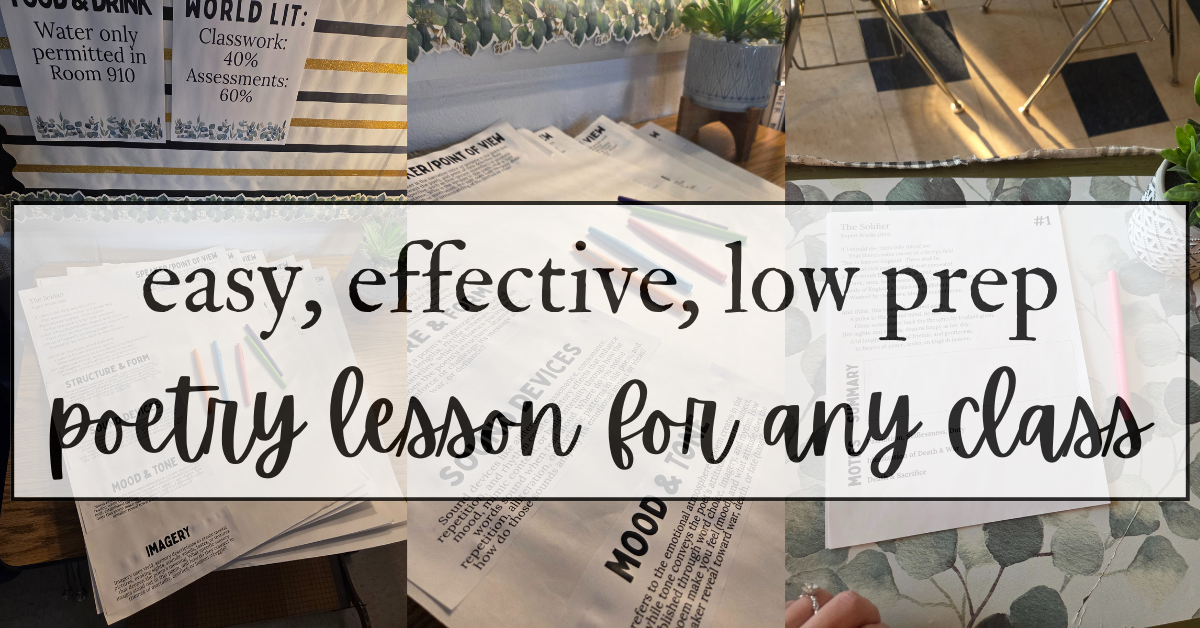
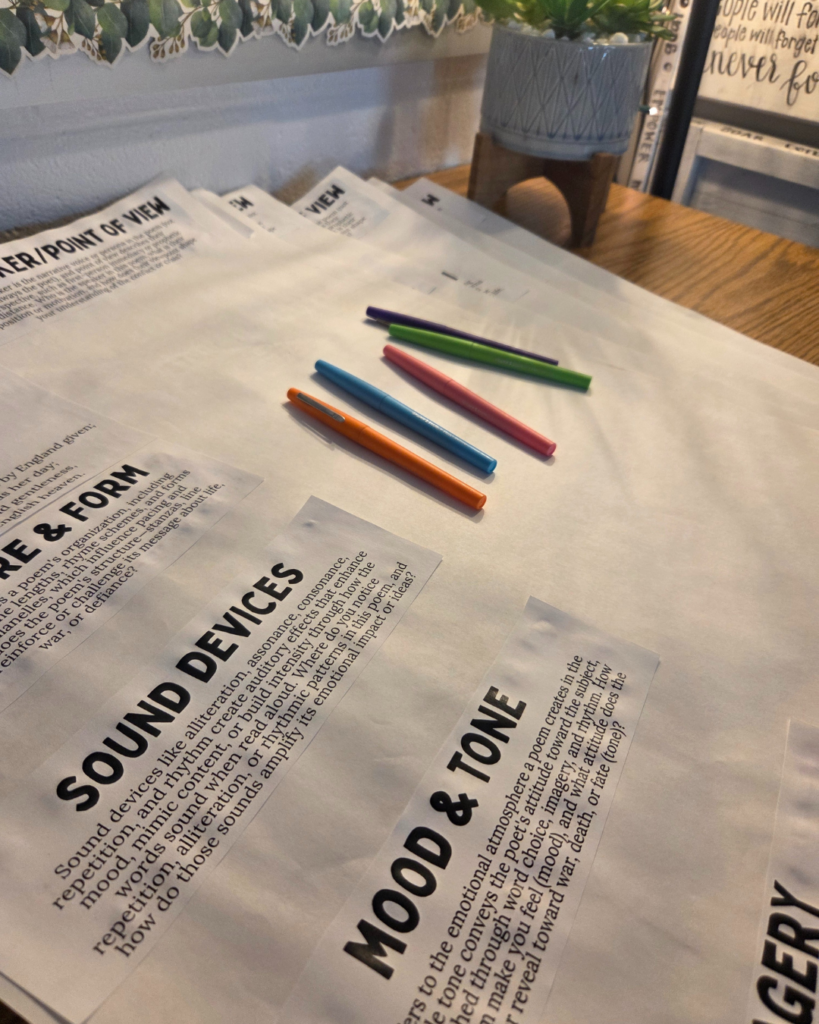
Then students move into small groups (think 2-4 kids, tops). With that group, they’ll rotate through 5 or 6 stations. Spaced out around my classroom is each poem enlarged on a poster. That poster also has 5 or 6 literary elements (again, which ones depends on the poetry we read that day). Some ideas include structure and form; sound devices; imagery; symbolism; mood and tone; and motif and theme.
Ahead of time, I make the posters. This is the most time-consuming part of this low-prep poetry lesson. I print out the poem and labels featuring the literary elements. But you could save yourself time by handwriting (or having the kids write) the elements.
Students are given a designated amount of time at each poster. Individual groups study a different poem each cycle. But everyone addresses the same literary element. I find this allows me to preview the concept briefly before giving students the green light to discuss.
Once the timer expires, students move to the next poster and thus the next literary element. By the time we’re done, they’ve reviewed all poems in our “playlist” and looked at them from different literary vantage points. Plus, they have the added benefit of seeing what each group before them wrote.
The final step of this low prep poetry lesson is the summarizer. For me, it’s an exit slip on which students write a comparative paragraph. The objective is for students to draw meaningful connections and parallels between the poetry and literary elements. I allow students to first brainstorm their answer with their group. Then they go back to their seats to complete the final task individually.
Step One of your Low Prep Poetry Lesson: Curate your Poetry
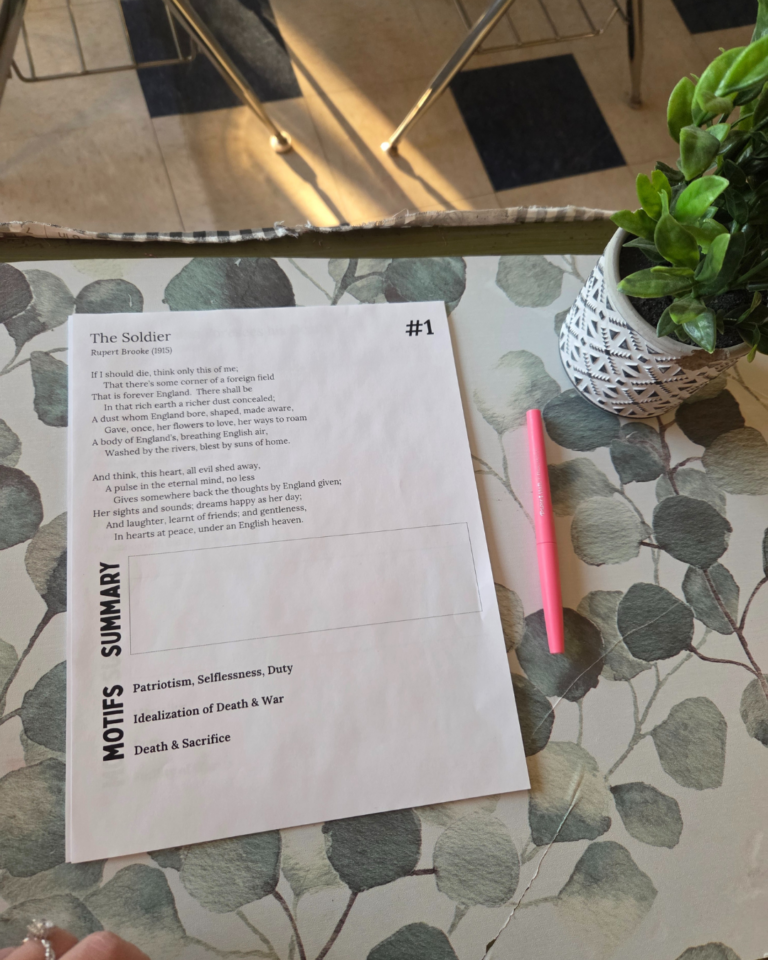
The first step is to know what your students are studying. Curate your playlist, so to speak. For me, I teach British Literature and our final unit of the semester is the twentieth century. Though we study a variety of genres, I love to set aside a day for this low prep poetry lesson. I set my time frame from WWI to about 1960. My curated list includes:
- “The Soldier” by Rupert Brooke
- “An Irish Airman Foresees his Death” by William Butler Yeats
- “The Second Coming” by William Butler Yeats
- “The Force that Through the Green Fuse Drives the Flower” by Dylan Thomas
- “Do Not Go Gentle Into that Good Night” by Dylan Thomas
- “Not Waving but Drowning” by Stevie Smith
I am somewhat limited as to what my curriculum allows, as I’m sure you are as well. Repetition isn’t necessarily an ideal scenario. But I do feel that Yeats and Thomas are prolific enough to include twice.
Beyond that, for this low prep poetry lesson, I try to incorporate a variety of voices and perspectives. Many of these center around similar motifs and themes: mortality, war, restlessness.
Poetry Playlist Suggestions for Your Classroom
If you do have the freedom to choose your poems for this low prep poetry lesson, here are some suggested playlists:
- American Voices: Identity and Belonging
- “Harlem” by Langston Hughes
- “We Real Cool” by Gwendolyn Brooks
- “Barbie Doll” by Marge Piercy
- “Those Winter Sundays” by Robert Hayden
- “Still I Rise” by Maya Angelou
- Classic “Greats”
- “The Road Not Taken” by Robert Frost
- “Ozymandias” by Percy Bysshe Shelley
- “The Tyger” by William Blake
- “If–” by Rudyard Kipling
- “Sonnet 18” by William Shakespeare
- “War, Trauma, and Memory Across the World
- “Dulce et Decorum Est” by Wilfred Owen
- “Grass” by Carl Sandburg
- “The Death of the Bell Turret Gunner” by Randall Jarrell
- “The Diameter of a Bomb” by Yehuda Amichai
- “The Colonel” by Carolyn Forché
- Love, Loss, and Family
- “My Papa’s Waltz” by Theodore Roethke
- “Valentine for Ernest Mann” by Naomi Shihab Nye
- “One Art” by Elizabeth Bishop
- “Annabel Lee” by Edgar Allan Poe
- “Because I could not stop for Death” by Emily Dickinson
- Contemporary and Spoken-Word-Friendly
- “Eating Together” by Li-Young Lee
- “On Turning Ten” by Billy Collins
- “Introduction to Poetry” by Billy Collins
- “Hanging Fire” by Audre Lorde
- “Wild Geese” by Mary Oliver
Step Two of your Low Prep Poetry Lesson: Create Your Materials
Once you’ve decided on the poetry for your low prep poetry lesson, it’s time to put the materials together. For this lesson to be most effective, here are the simplest materials I use:
- Student Handout: I copy a set of the poetry for each student. This is what we begin with when we read the poems and summarize them. I encourage – but don’t require for time constraints – students to annotate
- Posters: As mentioned, this is the most time-consuming component of the low prep poetry lesson, but even so, it’s not all that bad. I grab enough poster paper for however many poems I’m doing. I enlarge each poem and print a set of labels based on the literary elements we’re studying. Then I cut and glue each poem and set of literary terms to one poster. You can always make this low prep poetry lesson even easier on yourself by handwriting those labels or having students write them
- Presentation: I’m a very visual person, so I project the poems up on my board via a Canva presentation. I highly encourage you to do the same.
- Summarizer: Finally, for this low prep poetry lesson, I print one copy of the summarizer for each student. But you could, once again, make your life even easier by having students type their response
Step Three of your Low Prep Poetry Lesson: Implement the Heart of the Activity
For me, this low prep poetry lesson has two main components: a large group reading of the poetry (for summary) and the group work component. Here’s how I handle each.
Part 1: Activator
The activator is designed so students can gain a baseline understanding of each poem. This includes a very preliminary summary with details like:
- Who is talking? Who is the poem about?
- Where and when does the poem take place?
- What are some main events that take place?
We read the poem and discuss the above questions in this low prep poetry lesson. I don’t spend more than about 3 or 4 minutes per poem. The goal is to save the majority of the time for the group work component.
As noted, I don’t dissuade students from annotating, but I also don’t make it a requirement. Again, that saves time and helps alleviate the concerns many have about poetry (“it’s too hard”; “it’s unrelatable,” etc.).
Part 2: Group Work
Arguably the most important portion of this low prep poetry lesson is the group work. Once we’ve read each poem for a summary, students put themselves into groups of 2-4. You can absolutely assign those groups, as needed. Then each group is directed to a poster.
Before we begin, I preview the objective and the literary element. The objective is for students to look a second time at a particular poem but this time from the vantage point of the prescribed literary element only. I then review the literary term and set a timer. Students are expected to discuss their answer before writing it on the poster. As this happens, I move around the room and check in with groups, offering guidance and encouragement (and redirection, if needed).
When the timer expires, I have students move to the next station. Their first task is to review what the group before them said. This helps not only solidify their understanding of the poem they just reviewed. But it’s also a way to ensure all of the poems are thoroughly reviewed and analyzed from several vantage points. Then I detail the next station’s literary element (different from the first) and set the timer. The expectations are the same. I use this time to move around the room.
We repeat the process for as much time as we have or as many literary elements as we have.
Step Four of your Low Prep Poetry Lesson: Assess Students
Before students formally complete the summarizer for this low prep poetry lesson, I preview the prompt. Then I allow them to work in their groups to bounce ideas off one another. For my twentieth century lesson, mentioned earlier, here is my summarizer prompt:
- Prompt: After completing the gallery walk, choose at least three poems from our 20th century poetry set and select one or more literary elements we analyzed (mood and tone, imagery, structure, sound devices, or speaker and point of view). Write a 5+ sentence paragraph that compares how those elements function across the poems to convey ideas about war, mortality, defiance, or human struggle. Directly reference specific lines or images from the poems (paraphrase or quote briefly) as evidence, and explain the effect of the authors’ choices on readers. For example, you might compare how speakers in two poems confront death, or how sound devices build tension around violence in a third.
I do not put the pressure of direct quotations on students. Thanks to my moving about the room, I have enough distributed summarization data to know that students worked directly with the texts. Instead, I want students to really focus on the meaning behind the poems and how the literary elements connect those meanings across the poems we studied.
Personally, I do not grade the posters, though I review them and hang them up in my classroom. I opt to grade the summarizer so I can individually assess students’ understanding. I prefer this over dealing with the headache that sometimes is “group projects.”
Final Thoughts for this Low Prep Poetry Lesson
Hopefully you can see that this low prep poetry lesson is easy and effective and can be implemented across such a diverse range of poetry and curricula.
If you, too, study twentieth century British literature, your life just got even easier: I’ve linked my entire lesson – answers keys and Canva presentation included! – right here.
Comment below if you have other ideas to share about how best to implement poetry in your classroom!